Home › LED masks › More LEDs better?
The science · updated June 2026
Do more LEDs make a better LED face mask?
"254 LEDs." "Over 600 LEDs." The LED count has become one of the loudest numbers on a spec sheet. The implied message — more is better — is only half true.
I know this market closely. I've used LED masks since the early days, and years ago I came close to launching my own device — I walked away because I refused to put my name on a generic catalogue mould whose flaws I already knew too well, and tooling a better one was too costly. Since launching my boutique Skin Cafeine, I've also seen the back of the industry through endless white-label sales pitches. So here's the honest version.
A single LED lights a cone, not a dot
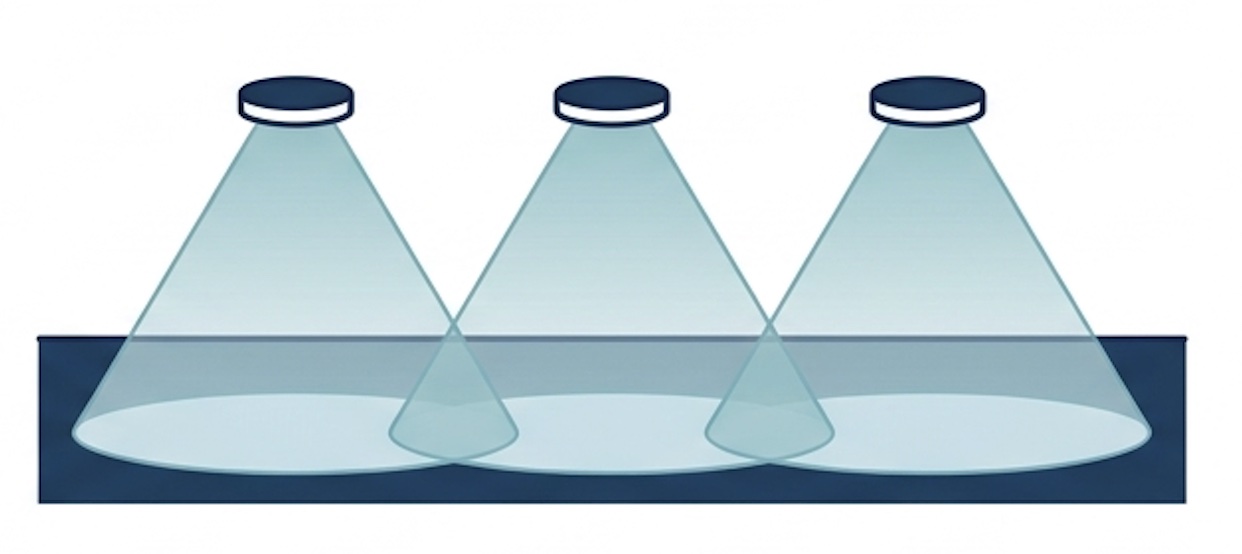
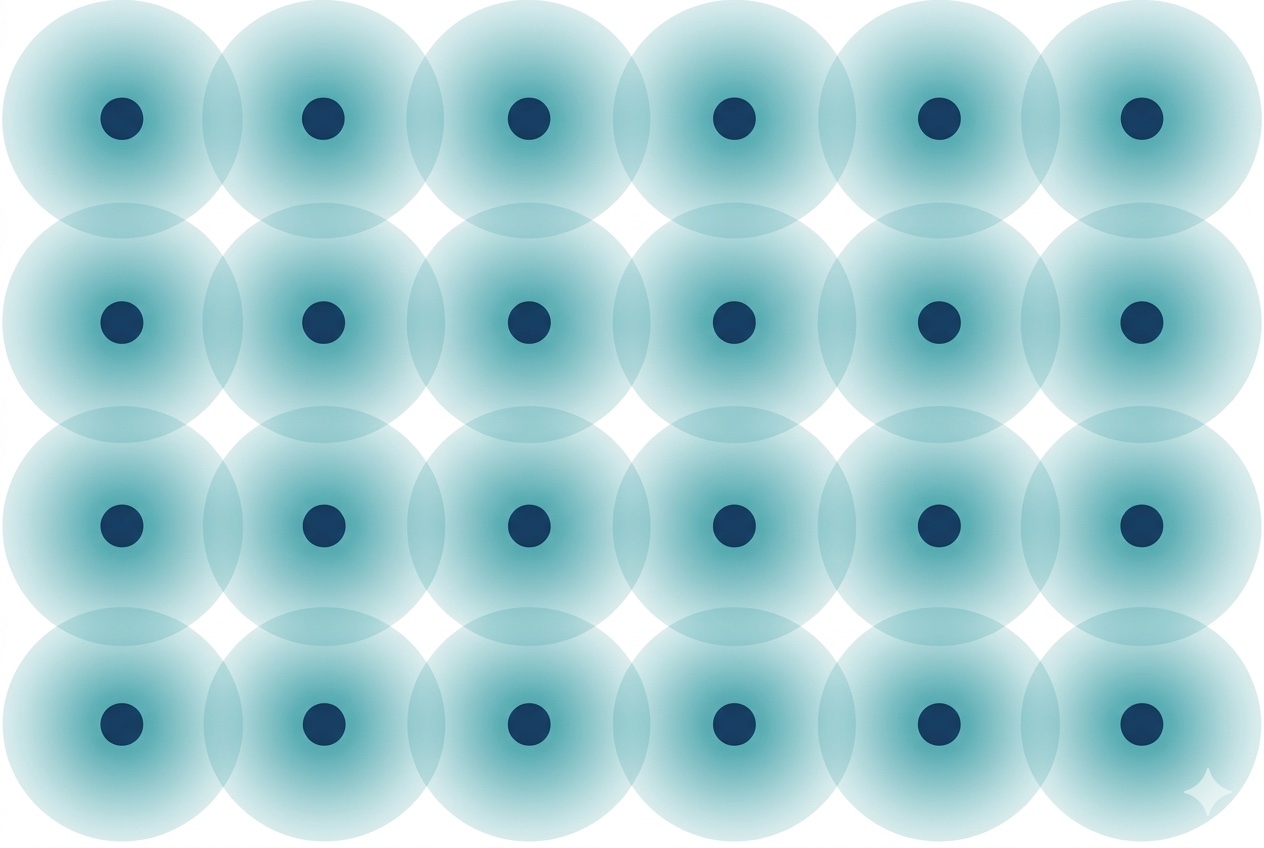
A LED doesn't fire a thin laser beam; it emits a cone of light that widens as it travels. Twenty centimetres away, that cone has spread out and overlaps generously with its neighbours. But pressed against the skin — near-zero distance — the cone hasn't had room to open. Each LED now lights only the small patch directly in front of it.
The problem of dark corridors
On a contact mask with few, widely spaced LEDs, there are inevitably strips of skin between the LEDs that receive very little light. The cells there don't get the intended dose, and you end up with a checkerboard: some areas well covered, others almost skipped — especially the fiddly spots like the upper lip (the "barcode" lines that appear with age), the sides of the nose, or the jawline.
Few LEDs, spaced
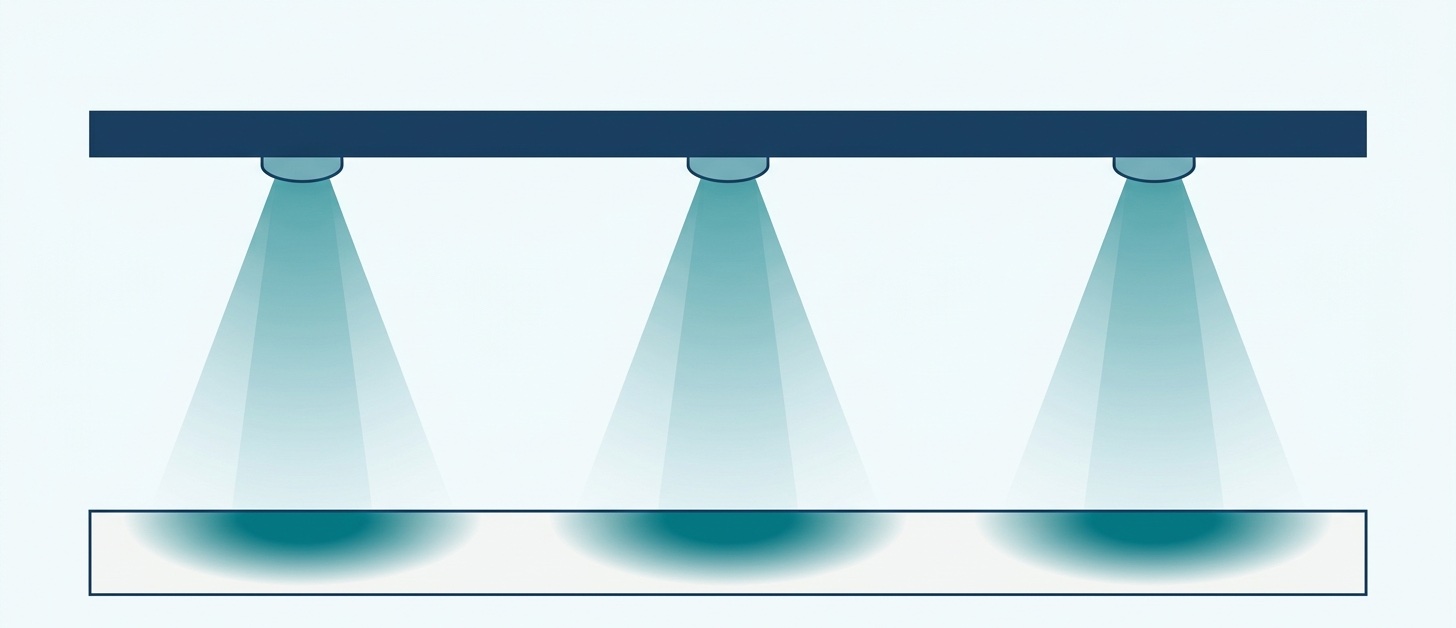
Each LED lights an isolated patch. Between them, corridors of skin get little or no light, so the dose varies a lot from one spot to another.
Dense mesh, no gaps
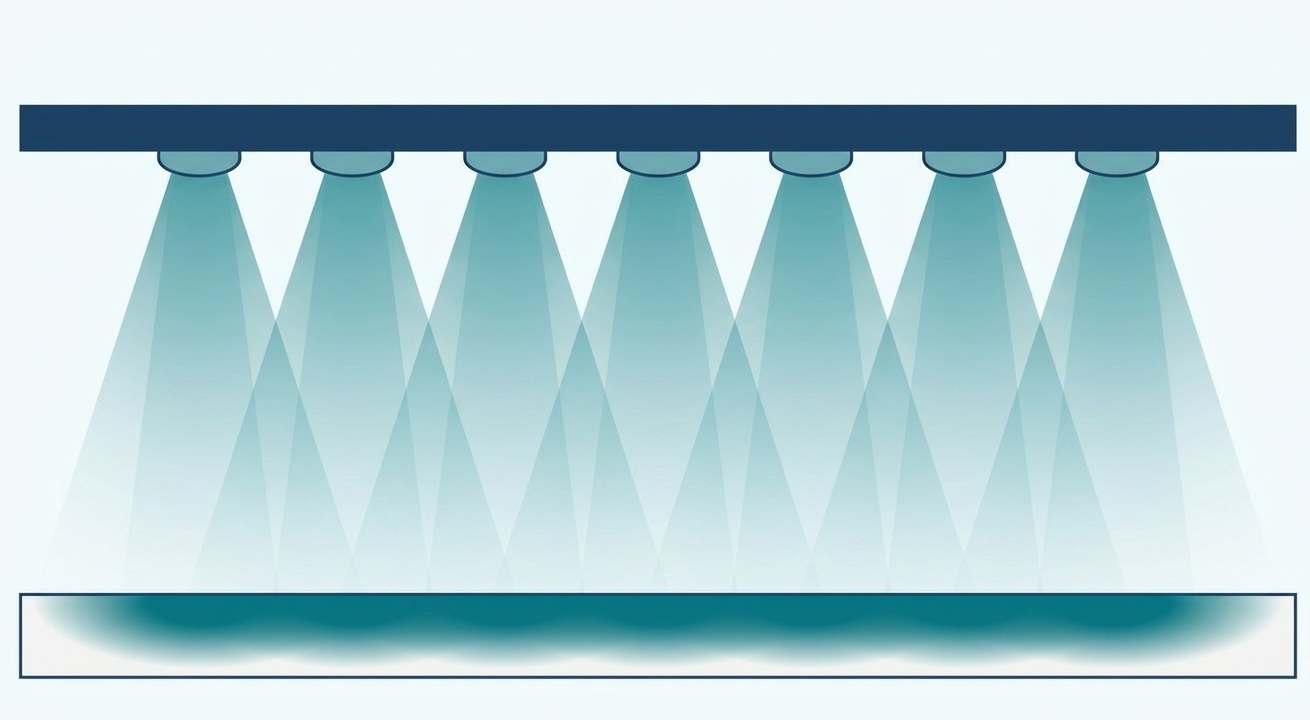
The lit areas meet and overlap. No dark gaps left: the whole surface of the face receives an even amount of light.
Why adding LEDs changes the picture
This is where density earns its keep. Pack more LEDs closer together and the small lit patches start to touch, then overlap. The dark corridors disappear and the whole face — relief and all — receives a more even dose.
Density is not the same as power
This is the nuance people miss. A LED in front of your skin delivers a certain irradiance; adding LEDs beside it doesn't change what that one delivers — it just fills the gaps around it. Density improves uniformity, not intensity. They're two different qualities, and I unpack the second one in how to read an LED mask's power.
One more caveat: perfectly even coverage at the wrong dose is still the wrong dose. In photobiomodulation there's an ideal range — not too little, not too much. Density is a condition for uniformity, not a guarantee of results. A good mask combines both: the right dose, evenly spread.
At-distance devices: density matters less
Everything above is about contact masks. For a panel or a rigid mask held a few centimetres off the face, the cones have room to widen and overlap before reaching the skin, so even a modest LED count can give uniform coverage. For those formats, the raw number is a much weaker signal. "300 LEDs" and "600 LEDs" simply don't mean the same thing depending on whether a device works at contact or at a distance.
FAQ
Do more LEDs mean a more powerful LED mask?
No. Adding LEDs doesn't raise the intensity your skin receives at any given point — that's irradiance, a separate property. More LEDs mainly fill the gaps between them, improving how evenly the light is spread.
How many LEDs should a good face mask have?
There's no magic number. On a contact mask, a denser array helps avoid under-lit 'corridors', but placement matters as much as the raw count. On a mask used at a distance, the count means much less because the light spreads out before it reaches your skin.
Is a 600-LED mask better than a 200-LED one?
Only if everything else is comparable and it's a contact mask — then more LEDs help uniformity. But a well-placed 200-LED mask can out-perform a poorly designed 600-LED one. Count is one clue, not a verdict.